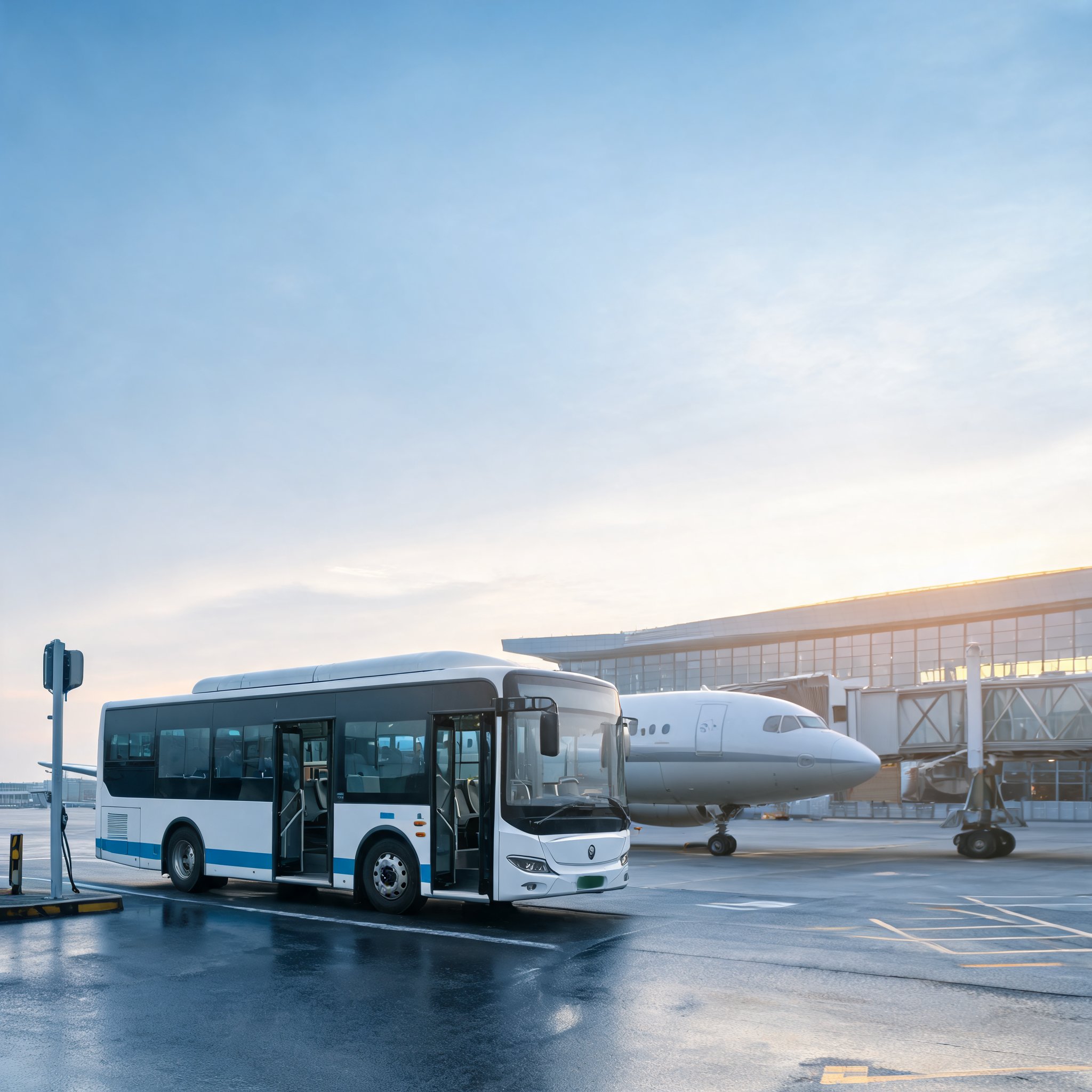
Ground handling company dnata is adding four battery-electric passenger buses to its operation at Rome Fiumicino Airport. The vehicles are due to start carrying travellers between terminal buildings and aircraft from mid-November.
The buses are Cobus's VEGA model, developed specifically for work on the apron. According to dnata, it will be the first ground handler to put the new model into service. The company says the vehicles hold more passengers than conventional airport buses, and that redesigned doors should speed up boarding and alighting. Revised air conditioning is meant to improve comfort during the short trips across the tarmac. dnata has not disclosed battery capacity, range or charging power for the vehicles.
Apron buses shuttle passengers between the terminal and aircraft parked on remote stands, so their capacity and the time they spend at each door bear directly on how quickly a turnaround can be completed. dnata's emphasis on passenger numbers, door layout and cabin cooling reflects those constraints, while the missing battery figures leave the vehicles' duty cycle on a single charge unclear.
Fleet grows beyond 40 buses
The four additions take the bus fleet at Fiumicino beyond its current 40 vehicles, of which 23 are already electrically powered. dnata presents the purchase as a way to make apron handling more efficient and to keep aircraft turnaround times as short as possible.
The order sits inside a wider modernisation programme in Italy. Over the past three years dnata has invested more than €30 million there, buying more than 550 new ground handling equipment units across Rome Fiumicino, Milan Malpensa and Milan Linate. The purchases range from passenger buses to baggage tractors, conveyor belts, passenger stairs, aircraft loaders and pushback tractors, covering most stages of the turnaround.
Over 60 per cent of Italian equipment electric
Across the three airports dnata operates more than 1,000 motorised ground handling units, and by its own account over 60 per cent of them are now electrically powered. Where full electrification is not yet operationally feasible, the company is gradually converting diesel-powered equipment to run on hydrotreated vegetable oil (HVO), which it treats as the interim option for machines that cannot yet go electric.
How fast the rest of the fleet can be switched depends partly on charging capacity at the airports. dnata says it is working with the respective airport operators to expand that infrastructure. The company did not say how many further electric buses it intends to order at Fiumicino, or when the remaining diesel units might be replaced.
The Italian business employs around 5,000 people and serves more than 60 airlines. At its three locations dnata handles over 150,000 flights, 46 million passengers and nearly 18 million pieces of baggage a year.