Aluminum casthouses face a growing challenge: raising recycled-metal use without compromising melt quality, recovery rates or production efficiency. Lightweight scrap, machining chips and other low-density post-consumer material are difficult to introduce into conventional melting furnaces, making efficient feeding and submergence essential.
Consistent temperature and chemical composition throughout the molten bath are critical to specification-compliant aluminum. Circulation and stirring equipment must support heat transfer and metal movement while limiting interruptions and excessive metal loss. Conventional mechanical pumps rely on immersed rotating components that can deteriorate through exposure to molten aluminum, dross and refractory debris.
Zmag America, Ltd. develops magnetic engineering solutions for molten-metal circulation, furnace stirring and scrap recovery. Its history traces to magnetic engineering and eddy-current separation, used to recover non-ferrous metals from mixed streams. The company later expanded into molten-metal applications and developed its patented zPMC permanent magnetic circuit as the foundation for equipment that stirs, circulates and submerges material in molten aluminum.
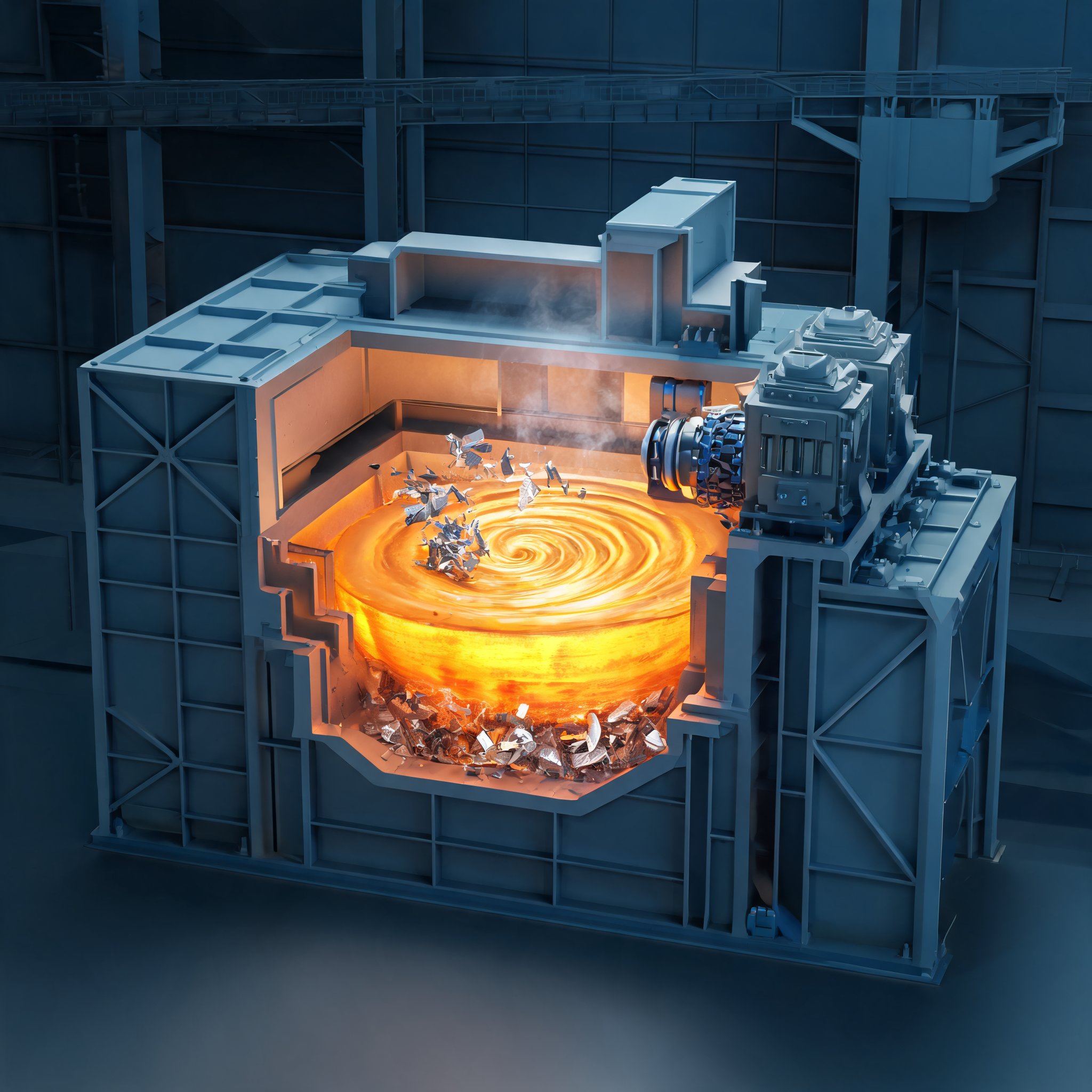
Zmag says zPMC uses a permanent magnetic circuit, rather than a conventional electromagnetic stirring arrangement, to generate the field that moves molten metal. It describes the resulting movement as a virtual impeller, producing circulation without immersed mechanical impellers. In an August 2025 interview with AL Circle, Zmag America president Eishin Takahashi identified limited familiarity as a barrier to wider U.S. adoption, saying producers globally tend to be conservative and prefer equipment and processes they already know.
Stirring and pumping without immersed impellers
MagStir is a non-contact stirring system for melting and holding furnaces. It uses the permanent magnetic circuit to homogenize temperature and alloy composition across the bath. Configurations cover furnaces from 15 to 200 metric tons, and the absence of an immersed mechanical stirring component offers casthouses a way to improve circulation without adding moving parts to the molten-metal environment.
New Zealand Aluminium Smelters installed MagStir in a casting furnace and later extended its use to additional furnaces; a 2017 technical case study reported improvements in temperature control during furnace preparation. Rio Tinto-operated Boyne Smelters in Queensland, Australia, fitted a unit to a casthouse furnace in 2019.
MagPump extends the approach to pumping and circulation. It fits a standard pump well without furnace modification, uses no physical impeller and is marketed as nearly hands-free with no consumable parts and minimal downtime. During a seven-week trial at the TANDEM Division of U.S. secondary aluminum producer TST Inc. in Fontana, California, MagPump replaced an existing mechanical pump. The findings described smooth operation and reduced disturbance to the molten-metal surface; plant management said it avoided the splashing seen with conventional pumping as metal level fell during draining.
At the TMS 2023 Annual Meeting and Exhibition, its use in side-well, multi-chamber furnaces was discussed, including potential for gas injection and scrap submergence alongside primary metal circulation.
Addressing chips and low-density scrap
Typhoon focuses on scrap submergence and chip melting, introducing lightweight aluminum scrap and machining chips beneath the molten-metal surface rather than leaving them at the top of the bath. Its magnetic circuit creates a vortex-like movement that draws material into the melt. Neuman Aluminium's Marktl facility in Austria incorporated a Typhoon system into a furnace modernization project aimed at low-density post-consumer scrap, including fractions with bulk density around 375 kg/m³ that had challenged conventional charging and melting.
Neuman targeted one metric ton per hour while continuing to melt solid charge in the same furnace. During operation, the system processed almost twice the planned scrap quantity within the expected time without disrupting normal operations, according to the published account. The company reported low operator involvement and no negative impact on melt or finished-product quality. Typhoon operates at 5-15 kW, including its air-cooling blower, and can submerge up to five metric tons per hour of machining chips, according to the published technical account; its vortex intensity is adjustable and can maintain metal movement when scrap or alloying material is not being charged.
Competitive landscape
The competitive landscape includes established suppliers, though not all offerings are direct equivalents. ABB supplies AL-EMS electromagnetic stirring for melting, holding and alloying furnaces and reports more than 430 installations; in April 2026 it announced an Arconic order for a fifth stirrer at a Hungarian casthouse. Presezzi Extrusion Group offers the L.E.C. low-energy stirrer for melting and holding furnaces, alongside remelting and complete casthouse equipment.
Pyrotek's casthouse portfolio includes electromagnetic pump systems and LOTUSS low-turbulence scrap submergence. Its EMP systems use electromagnetic forces to circulate molten aluminum and support metal transfer and scrap charging, while LOTUSS uses a circulation pump and refractory well to submerge lightweight scrap. Rockwell Automation operates in adjacent industrial automation rather than offering a like-for-like permanent-magnet stirrer; its aluminum work includes furnace and ladle-shop control systems, such as a modernization project for Mozal Aluminium's casthouse.
As producers incorporate more challenging recycled feedstock, managing molten-metal movement without conventional immersed mechanical components could become an increasingly relevant consideration.