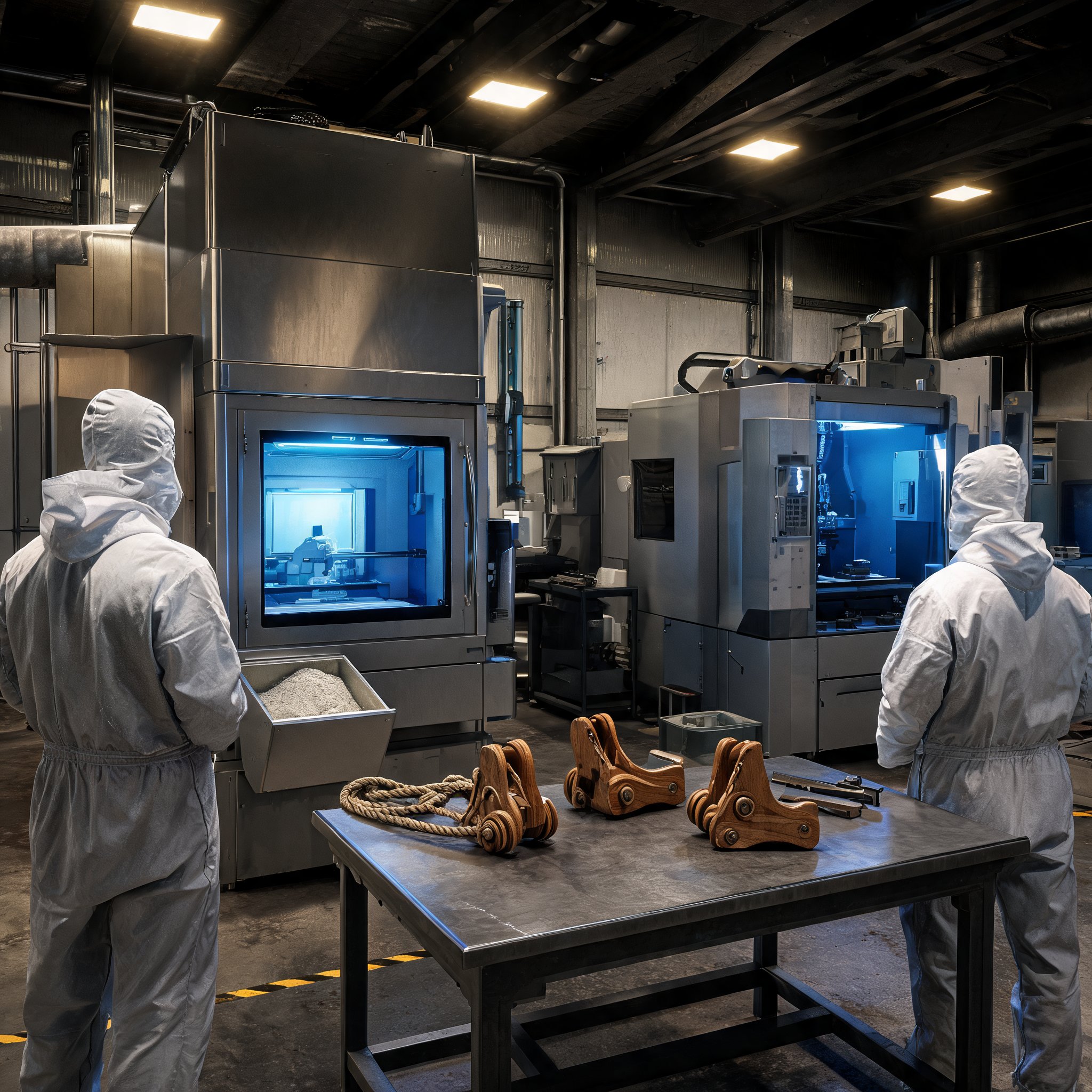
At Portsmouth Dockyard, the Admiralty could specify the sizes and quantities of wooden pulley blocks before the last Brunel and Maudslay machines had been built. By 1808, 45 machines were producing 130,000 blocks a year. The episode is usually told as a feat of British invention. It was also a feat of customer demand: the Navy knew what it used, watched the first machines work and could place the next order with confidence. Ahead of Formnext 2026 in Frankfurt, where the UK is partner country from 17 to 20 November, British additive manufacturing faces a version of the same question: who ends up making the parts?
The research base is not in doubt. Additive Manufacturing UK's 2026 annual plan puts the UK market at £515m–£740m in 2024, or 3%–4.3% of the global total. The European Patent Office counted 1,925 international patent families in additive manufacturing originating in the UK between 2001 and 2020, close to France's 1,938. Neither measure shows how much production takes place in Britain. A patent family records an attempt to protect an invention; a market estimate can include machines bought from overseas.
Invention travels; production follows customers
Company histories show both the strength and the limits. Wayland Additive grew out of a team with electron-beam experience in semiconductors. In October, its Calibur3 metal additive system left Huddersfield for the University of Innsbruck, where Austrian researchers will use it on difficult materials, including high-temperature alloys. Britain built and exported the machine; part of the process knowledge will be accumulated abroad.
Alloyed, which began in Oxford materials research, licensed a cast nickel alloy to Hitachi Metals in 2018. It later opened component development and production facilities in Abingdon and Seattle, and its Seattle operation sold its first flight parts in 2023. That is a more diversified commercial path: licensing, UK component work and U.S. aerospace supply. It also shows that the location of the next order matters as much as the origin of the patent.
The gap between a project and a business
Jake Hand, co-founder of Exeter-based Rapid Fusion, describes a funding gap familiar to small equipment builders. The company, which grew out of distributor Evo 3D and now makes large-format additive systems, is profitable without R&D funding, he says. Innovate UK support has helped it develop technology and share costs with partners. His criticism concerns what happens when a project succeeds: in his view, funders back a project but not always a business. The award buys engineering time to solve a defined problem. The customer then asks whether the machine can make a particular mould, who will train the operator and what happens if a job stops halfway through. Answering those questions for a single sale can take months.
The Kingston University installation shows how a first reference customer can emerge. A graduate named Raghav who joined Rapid Fusion brought his employer and his old university together, according to Kingston operations manager Lesley Stigling. The result was a £450,000 Zeus robotic cell at the Roehampton Vale campus, combining large-format printing with CNC milling. Kingston can bring work in-house, offer the equipment to industrial partners and teach students on it. The manufacturer gets a customer that can show the machine working.
Hydra Manufacturing, a University of Leeds spin-out developing equipment for technical ceramics, is at an earlier stage. In March it announced £320,000 in equity investment led by SFC Capital; including earlier grants, it had secured about £577,000. Louis Masters, the founder, was considering raising around £1m or more when he spoke to the publication. He understands why investors want to see two more installations: a machine on a customer's factory floor is stronger evidence than an encouraging email. The difficulty is that winning those customers and developing the equipment draw on the same limited capital. Selling and raising take time away from each other.
Equity, qualification and the installed base
University ownership is another filter between research and a company. John Robinson, additive manufacturing research commercialisation manager at the University of Wolverhampton, incorporated a company in May 2017 that funded his PhD and says he and the university filed several patent applications together in 2024. His research includes multi-material devices that carry heat away from data-centre equipment. He recalls the former technology transfer office wanting 75% of the company; more recent discussions with the university's enterprise team were about a potential 10% stake. Both were proposals. The first would have left a quarter of the equity before outside investment, with later rounds diluting it further. National data suggest universities have been moving in the same direction: the Royal Academy of Engineering and Dealroom found that the average non-cash stake taken by universities in UK deep-tech hardware spin-outs in their sample fell from 25% in 2015–19 to 14% in 2024–25. The 2025 data were partial.
Commercialisation also depends on qualification costs that fall on the supplier. Jason Hutt, managing director of Fastech, points to the incumbent's advantage: casting is already approved. An additively manufactured replacement may perform well in material tests and still require evidence specific to the equipment, process and grade a customer has specified. A second buyer may ask for much of that work again. For a run of 50 parts the arithmetic looks very different from a run of 5,000.
The £38m Airbus-led DECSAM programme is one attempt to share that burden in civil aerospace. Renishaw, GKN Aerospace, Apex Additive Technologies, the Manufacturing Technology Centre and other partners are working on ground and flight demonstrators and guidance on qualification. That lets suppliers learn what a major customer will require while processes are still being developed. A production contract would be a further decision for the buyer, and the decision that would let a supplier add a second shift.
Installed capacity shapes skills as well as costs. Will Richardson, chief executive of Wayland Additive, argues that firms do not get good at production without doing it. A small domestic installed base means each company must train more of its own operators; an engineer from CNC machining can learn an additive system, but in a region with several factories running the equipment an employer can hire someone who already knows how to prepare builds and keep a machine productive. Renishaw's Ben Deary and Ed Littlewood describe a related problem for companies bringing production back after years of buying overseas: a supplier once relied on for a component or service may have disappeared. Apex, a Welsh specialist, helps customers rebuild that expertise by developing process parameters, making first parts and proving the process before the buyer decides whether to take production in-house.
What a demand signal would change
Customer behaviour is not simply a matter of caution. Craig Pyser, chief executive of AMufacture and chair of AMUK, says 95%–98% of the Portsmouth company's work is now production. It began in marine; over the past year defence has become its largest sector, with marine and automotive also significant. Some defence customers revise designs every six to eight weeks, so conventional tooling may be out of date by the time it is ready. A local manufacturer able to take a revised file and deliver the next batch can win repeat orders even while the product changes. When one customer bought a printer to bring work in-house, AMufacture helped it get running; two years later the customer sold the machine back, having found that software, staff and post-processing made the operation more expensive and demanding than expected. The work stayed in Britain, with a specialist able to spread the costs across several accounts.
Public procurement could provide a stronger signal. James Selka, chief executive of the Manufacturing Technologies Association, told a House of Lords briefing on 12 November that investment was poised to enter British manufacturing but needed a proper demand signal and co-investment from government; he put energy prices first among immediate obstacles. Lord Harrington of Watford, chair of Make UK and a former business and industry minister, recalled that sector deals worked where companies could put substantial sums alongside public money. Elsewhere, some businesses that government wanted to encourage could scarcely afford their share. He also chaired GeoPura, a hydrogen power business that tried to raise further capital in Britain and ended up being sold to Canada's Ballard Power Systems for £275m upfront in August.
Fusion is a test case. In 2025 the UK Atomic Energy Authority commissioned two additive systems at its Central Support Facility: a Freemelt electron-beam machine for tungsten work and a Nikon SLM laser system supplied by Kingsbury Machine Tools with support from Additure. That gave a British public institution access to equipment made by international manufacturers. In separate fusion maintenance projects, UKAEA reports that British participants including Laser Additive Solutions, The Welding Institute and WAAM3D contributed to inspection and repair work.
The distinction matters. A UK laboratory can learn to produce a component on an imported machine. A British machine builder needs to know when the next equipment specification will be drawn up; a repair specialist needs to know whether development work leads to a maintenance contract. UKAEA publishes a quarterly procurement pipeline that separates possibilities over one to five years, pre-commercial work and confirmed requirements expected to go to tender. That is more useful than a general undertaking to support British industry, but a confirmed tender is still some distance from a repeat order.
Policy also has to avoid treating additive manufacturing as one mature technology. Added Scientific's researchers distinguish an established single-material process, where a buyer can specify and accept a printed stainless-steel part, from multifunctional devices that combine several materials in one build. The first needs commercial demand; the second may still need research funding to establish whether the device works.
Pyser has a concrete test for the Formnext showcase. An overseas company looking for a European base and choosing to establish it in Britain would count. So would a customer who saw a British-built machine in Frankfurt and ordered one, or a first installation that led to a second. Brunel received his answer in May 1803, when the Admiralty ordered machines for smaller blocks. A year from now, the more revealing question for the UK exhibitors will be who their next customer was.