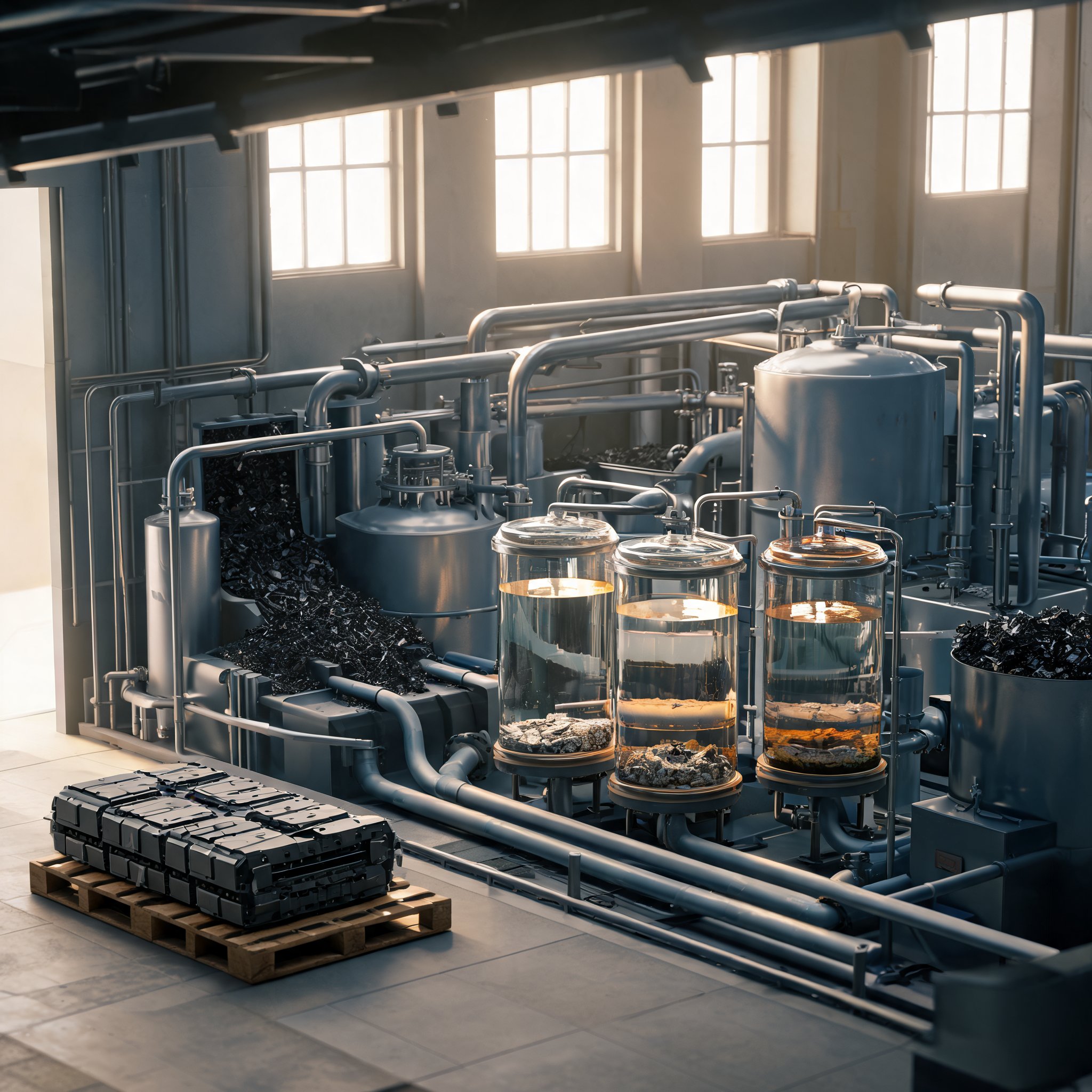
SPRIND, Germany's Federal Agency for Disruptive Innovation, is taking a stake in Aachen-based battery recycling specialist Cylib. The agency is investing an undisclosed sum and will become a shareholder in the startup, which was founded in 2022 and says it is close to commercialising its recycling processes.
The partners described the purpose of the investment only in general terms: SPRIND is helping Cylib "to further develop its technology and scale it to industrial maturity". Cylib's hydrometallurgical plant is currently under construction in Dormagen, North Rhine-Westphalia.
According to Cylib's management, the case for backing the company rests on two converging trends: Europe has little access of its own to the raw materials that are critical for battery production, while the number of end-of-life electric vehicle batteries grows every year. The company's aim is to keep those materials in a closed loop, returning them from spent batteries to new value creation.
A lithium-first hydrometallurgical route
The process Cylib is industrialising is based on research carried out at RWTH Aachen. Older recycling approaches concentrated on nickel and cobalt, with lithium recovered only at the end of the chain or lost in the slag. The company's water-based OLiC process, short for "Optimised Lithium and Graphite Recovery", instead recovers lithium in the very first steps from the black mass. Cylib states recovery rates of more than 90 per cent for lithium, graphite, nickel, cobalt and manganese.
"Our technology was born in research, and at cylib we have developed it to the threshold of industrialisation," said Dr. Lilian Schwich, co-CEO and co-founder. She described SPRIND as a partner that understands how important technological innovation is for critical value chains, and what it takes to bring it to market.
Olav Carlsen, Innovation Manager at SPRIND, framed the investment in market-building terms: breakthrough innovations also happen where a technology makes a new market possible. In his view, Cylib has the technological foundation to create a large-scale industrial market for battery materials that remain in circulation in Europe, which in turn strengthens the sovereignty of Germany and of Europe more broadly in critical raw materials.
Industrial ramp-up at two sites
Since September 2026, Cylib has been accepting end-of-life EV batteries at its first industrial site in Wernberg-Köblitz in the Upper Palatinate, processing them into black mass. The facility is being ramped up gradually and is designed for a capacity of up to 10,000 tonnes per year. In parallel, the company is building the large-scale hydrometallurgical plant in Dormagen where the raw materials will be recovered. The project is classified as a "Strategic Project" under the EU's Critical Raw Materials Act.
Porsche pilot as a practical test
Evidence for the viability of the process comes from a pilot project involving Cylib, Porsche and other partners. As the sports car manufacturer announced in September, cathode active material made entirely from recycled raw materials, sourced from Porsche's own high-voltage batteries, was produced for the first time. The cells manufactured from that material are currently undergoing testing.