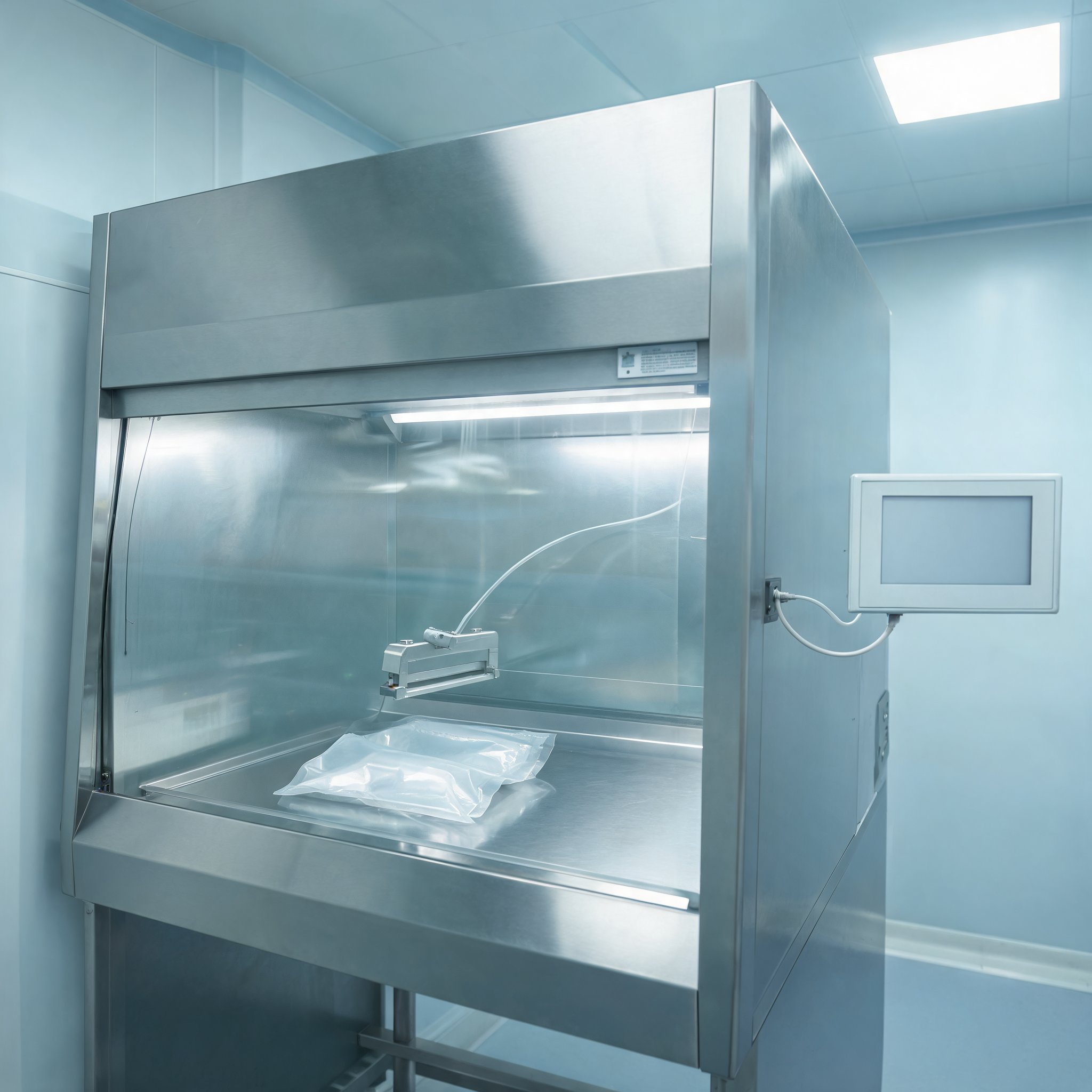
Packworld USA has introduced the PW4214, a compact remote impulse heat-sealing system intended for controlled environments in tissue banking and regenerative medicine. The company says the system is designed to produce repeatable, high-integrity seals while keeping bulky electronics out of the critical work area.
In tissue-banking and regenerative-medicine workflows, sealing often takes place inside a biological safety cabinet or laminar flow hood. The PW4214 separates the sealing head from the control module and touch-screen interface. Only the lightweight head sits inside the clean zone; the controls remain outside. Packworld USA says this arrangement is intended to preserve aseptic technique and process safety while making better use of limited workspace.
Designed for confined clean zones
The remote sealing head is described as easy to integrate with existing containment equipment and fixtures. That allows technicians to seal flexible sterile barrier systems in confined spaces. A smaller machine footprint is meant to improve access and maneuverability for handling human tissues and other biological materials.
Moving controls and electronics outside the clean area removes unnecessary bulk from the critical workspace. According to the company, this supports airflow integrity and simplifies wipe-down and sterilization. Detachable seal bars are intended to make maintenance faster and simpler, helping to maximize runtime.
Process control and compliance features
Packworld USA lists cleanroom-compliant construction as a standard feature. The system controls critical sealing parameters including temperature, time and pressure. It also provides data logging to support 21 CFR Part 11 compliance. The sealing zone is suitable for flexible film measuring 13 inches or less.
The company says the TOSS PIREG heat-sealing system can be used with the PW4214 to create hermetic heat seals across a range of films, including Tyvek, polyethylene, laminated foil and nylon, as well as high-temperature specialty films such as FEP and PFA. The system is described as ISO 11607 and RoHS compliant and includes TOSS touch-screen control for managing sealing parameters and pursuing consistent seal quality from batch to batch and operator to operator.
Related sealing developments
The launch comes amid other recent heat-sealing announcements in packaging. In May, Siegwerk introduced a heat-seal lacquer portfolio aimed at consistent sealing, hot-tack performance and bond strength in fibre-based and selected flexible packaging applications. More recently, Zerocircle presented a heat-sealable hydrophobic coating for paper cups made from natural polymers, intended to provide water and grease resistance for hot beverages without a polyethylene lining or PFAS treatment.
For the PW4214, the central claim is not a new chemistry but a physical separation of controls from the clean zone. That distinction matters in workflows where cabinet space is scarce and contamination control is critical. The company’s stated benefits—airflow integrity, easier cleaning, faster maintenance and repeatable seals—remain claims about the design rather than independently verified outcomes.