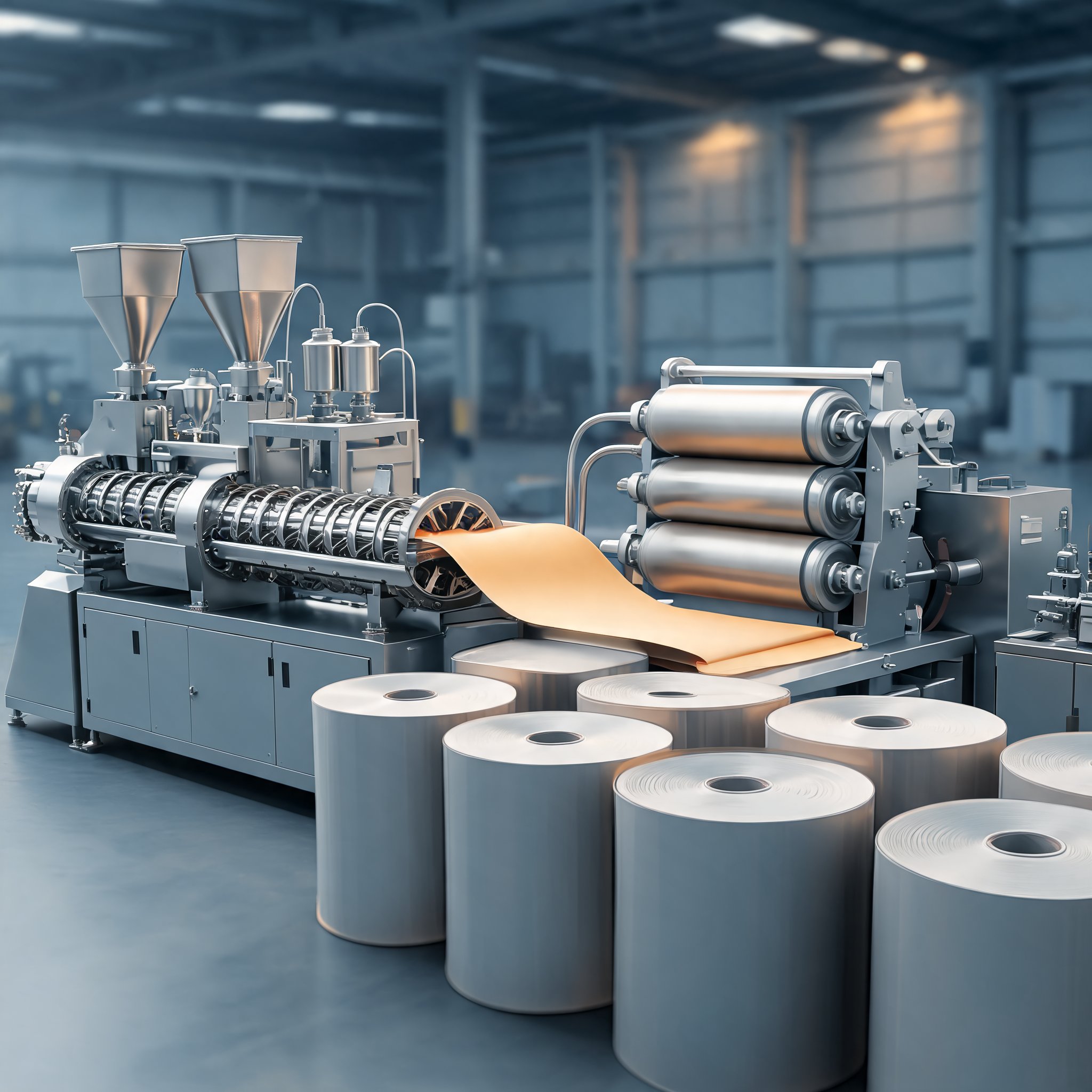
KraussMaffei Extrusion has introduced a continuous single-stage extrusion process, marketed as PVC InlineMixing, for the production of PVC roofing membranes. The company positions the approach as a replacement for the conventional two-stage route built around a separate heating-cooling-mixing combination; it says the new method cuts energy use, shortens production time and delivers a fast return on investment for the system.
In the established two-stage method, PVC powder, plasticizers, additives and fillers are first processed batchwise in a hot-cold mixer to create a dryblend. That mixture is then cooled, placed in intermediate storage and later plasticized in a twin-screw extruder before being formed into membrane. Under the new concept, all solid and liquid components are instead fed directly into the extruder through gravimetric dosing systems in the exact quantities required.
Cost and footprint effects
Because no separate mixing combination is needed, manufacturers avoid that capital investment, and the material is heated only once. KraussMaffei reports that energy consumption, and therefore energy cost, falls by up to 75 percent depending on the formulation, the system parameters and the plant location. Removing the batch mixing step also reduces the floor space the whole system occupies and lowers labor requirements; maintenance is lighter as well, since wear parts for the heating-cooling mixer are no longer necessary. The company frames the combination of lower capital expenditure and lower operating costs as improving overall cost-effectiveness and creating the conditions for a quick payback.
The process is also presented as more flexible. Formulation adjustments and color changes can be carried out during operation through the integrated control system, which the company says eliminates the preparation time and interim storage associated with separate dryblend batches. Christopher Bartel, Head of Sales Flat & Foam at KraussMaffei Extrusion, described lower production costs, greater flexibility and more efficient manufacturing as a clear competitive advantage for membrane producers, adding that they can react faster to new requirements, adjust formulations during the production process, and at the same time lower their energy and capital expenditure.
Validation and hardware
The process was developed at the KraussMaffei Extrusion Technology Center in Laatzen and validated using industrial roofing membrane formulations. The tests used a co-rotating twin-screw extruder from the ZE 65 BluePower series, equipped with loss-in-weight feeders for all solid components and multiple liquid feeders for free-flowing ingredients. The ZE BluePower series has a Da/Di ratio of 1.65; according to the company, the combination of high torque and large free volume provides a wide process window for handling different formulations flexibly.
Testing confirmed what the company describes as excellent gelation levels for the PVC and high product quality, with the mechanical properties and weldability of the membranes meeting industrial requirements across several formulations. Bartel said the results demonstrate the potential of PVC InlineMixing for industrial roofing membrane production, noting that customers can test their own formulations under production-relevant conditions at the Technology Center, optimize the process and prepare for industrial implementation.
One industrial production line already runs the process. The reference plant achieves a total throughput of 1,800 kg/h using two extruders and two calenders, processing PVC, additives and fillers together with the resulting edge trimmings continuously into finished membrane. KraussMaffei presents the approach as combining high product quality with a leaner production process for PVC roofing membrane manufacturing.