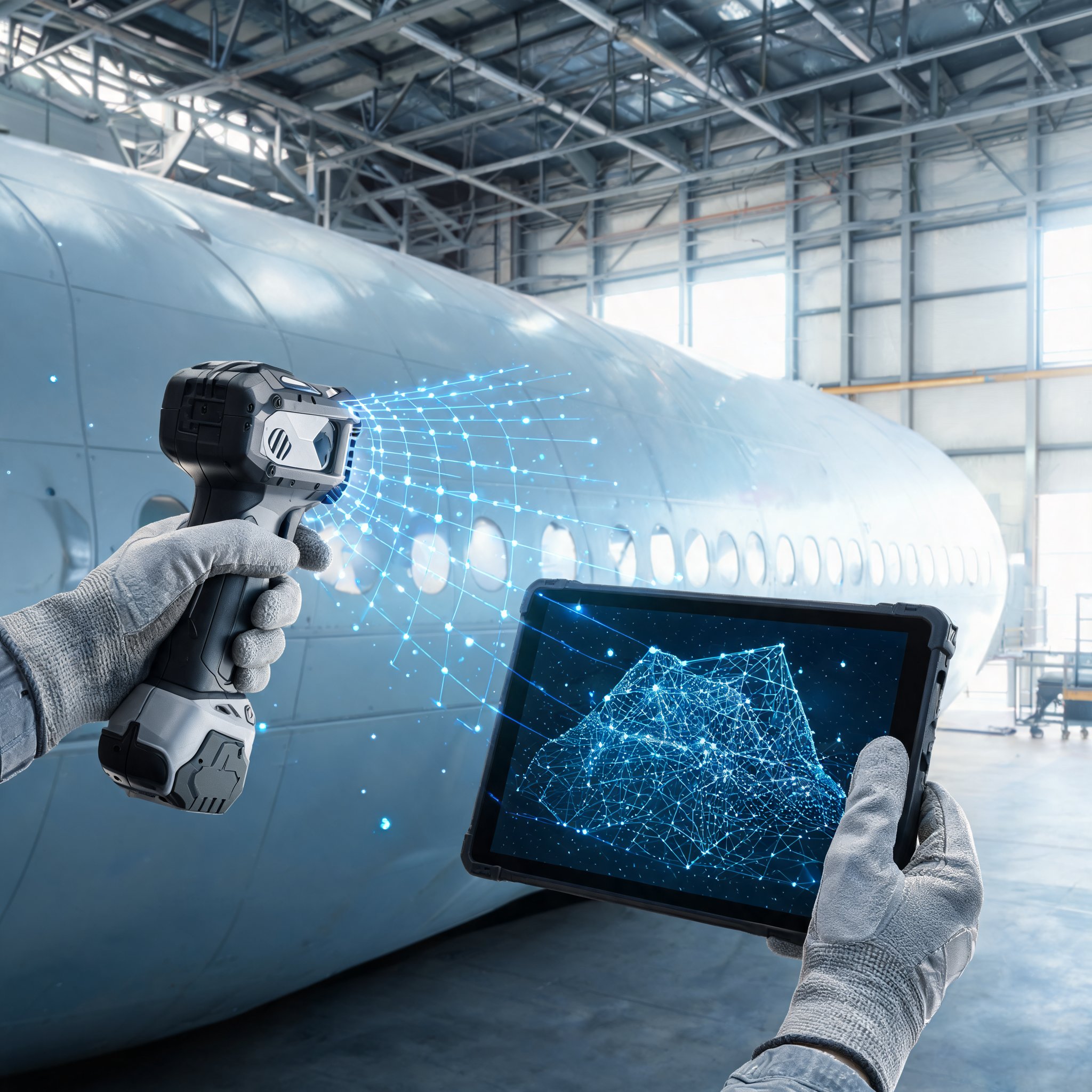
The HandySCAN 3D MAX Series is aimed at aerospace teams that need to measure large, complex components without relying solely on fixed metrology workstations. The series includes the next-generation HandySCAN MAX EVO and HandySCAN MAX EVO Elite, which extend the EVO platform to large-part measurement across quality control, quality assurance, maintenance, repair and overhaul, and non-destructive testing workflows.
Two accuracy tiers
The MAX EVO is specified with volumetric accuracy of 0.150 mm + 0.020 mm/m and is intended for aerospace product development. Its portable format is designed to let teams capture 3D measurements where aircraft structures and components are developed, inspected or maintained. The system is also described as suitable for a broad range of part sizes, complex geometries and difficult surface conditions, including highly reflective materials, without surface preparation. The product information points to fuselage sections, wings and structural assemblies as examples where the approach could reduce setup and disassembly requirements that slow inspection.
For quality and NDT work requiring higher precision, the MAX EVO Elite is specified at 0.075 mm + 0.010 mm/m. The MAX Series is said to maintain measurement reliability and accredited accuracy in accordance with ISO 17025 and VDI/VDE 2634 standards.
Inspection outside the metrology lab
Integrated photogrammetry is intended to support accurate measurement of large and complex parts outside controlled environments. That matters for aerospace maintenance, where inspections may need to take place on a hangar floor and aircraft downtime must be minimized. The product information says accurate 3D data can be captured without extensive setup or moving parts to a dedicated inspection area.
With the Mobility Kit, the MAX Series enables wireless, cable-free inspections for daily quality control. The practical aim is to bring inspection to the point of work and reduce dependence on fixed workstations, carts and cumbersome cable setups.
Feedback at the part
The EVO platform includes an embedded screen for scanner control and real-time data visualization. Keeping scan data and the physical part within the operator's line of sight is intended to make measurement work more comfortable, including complex, elevated and overhead scanning tasks. Real-time mesh visualization also lets operators check data coverage while scanning and identify missed areas before leaving the part.
For teams working in hangars and other real-world environments, the combination of mobility, continuous feedback and fast data acquisition is positioned to support a more efficient scan-to-report process. Technicians can move around large aircraft structures and hard-to-reach areas, capture data at the asset and complete inspections with less interruption to maintenance and quality workflows, according to the announcement.