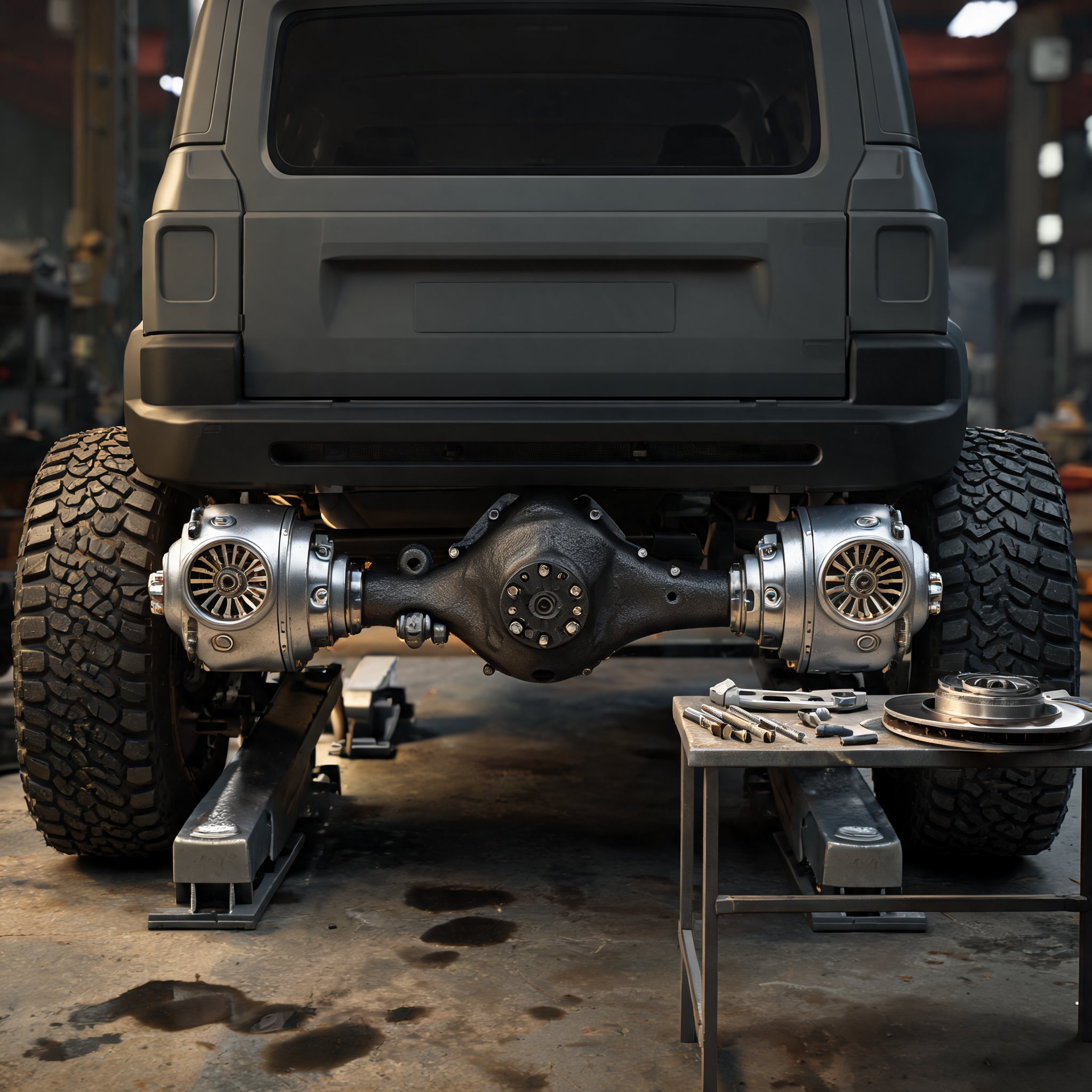
A rear-only portal axle conversion built for a Jeep XJ has come in at roughly one-fifth the price of the commercial portal axle sets that typically sell for around $20,000. The setup, assembled by Zeph Gage, combines a Ford 9-inch axle housing with geared hubs sourced from a Humvee and a set of HMMWV portal adapters from Jesse Haines Fabrication.
What a portal axle actually does
Portal axles are conceptually simple but dramatic in practice. Instead of letting axle shafts and driveline hardware hang below the vehicle, they place a stack of gears behind each driven wheel, which allows the axle tubes to sit far higher and leaves very little hardware below the frame line. Paired with tall tires, the arrangement can produce enough clearance that, as one off-road writer described it, you could hold a picnic underneath the parked truck.
Turning the differential upside down
Two-gear portals such as the Humvee units reverse the rotation of the input shaft. Gage addressed that by flipping the differential upside down so the driveline spins in the correct direction, then bolting a Yukon Gear and Axle third member to it. The result is effectively a high-pinion unit built from low-pinion parts that have simply been inverted.
The conversion adds about six inches of clearance, but that is not its only advantage. It also preserves full shock travel, a difficult thing to achieve with portal axles, and reduces stress on the differential itself. Gage's stated expectation is that the assembly should prove effectively bulletproof as a result, which remains a design claim rather than a verified outcome.
Why the front axle stays conventional
Fitting a portal only at the rear is a familiar trick in the remote-control rock crawling scene. Retaining a solid axle up front sidesteps the packaging constraints that usually appear when portal axles are added to a vehicle that never had them from the factory. It also means shock travel does not have to be restricted to make room, and ride height is not pushed absurdly high.
Fabrication and the payoff
This is not an off-the-shelf kit. Gage produced homemade brackets and custom-tapped plates, and paired a two-piece brake rotor with a Ford Fusion caliper, chosen partly because that hardware incorporates an integrated electric emergency brake solenoid and partly, again, for clearance.
The finished XJ can drive over a five-gallon bucket and still have several inches of clearance to spare, so the rear end is less likely to hang up on obstacles that the front end can simply steer around. A video from Outdoor Auto covers further specifics, including how the gearing was matched between the front and rear axles.