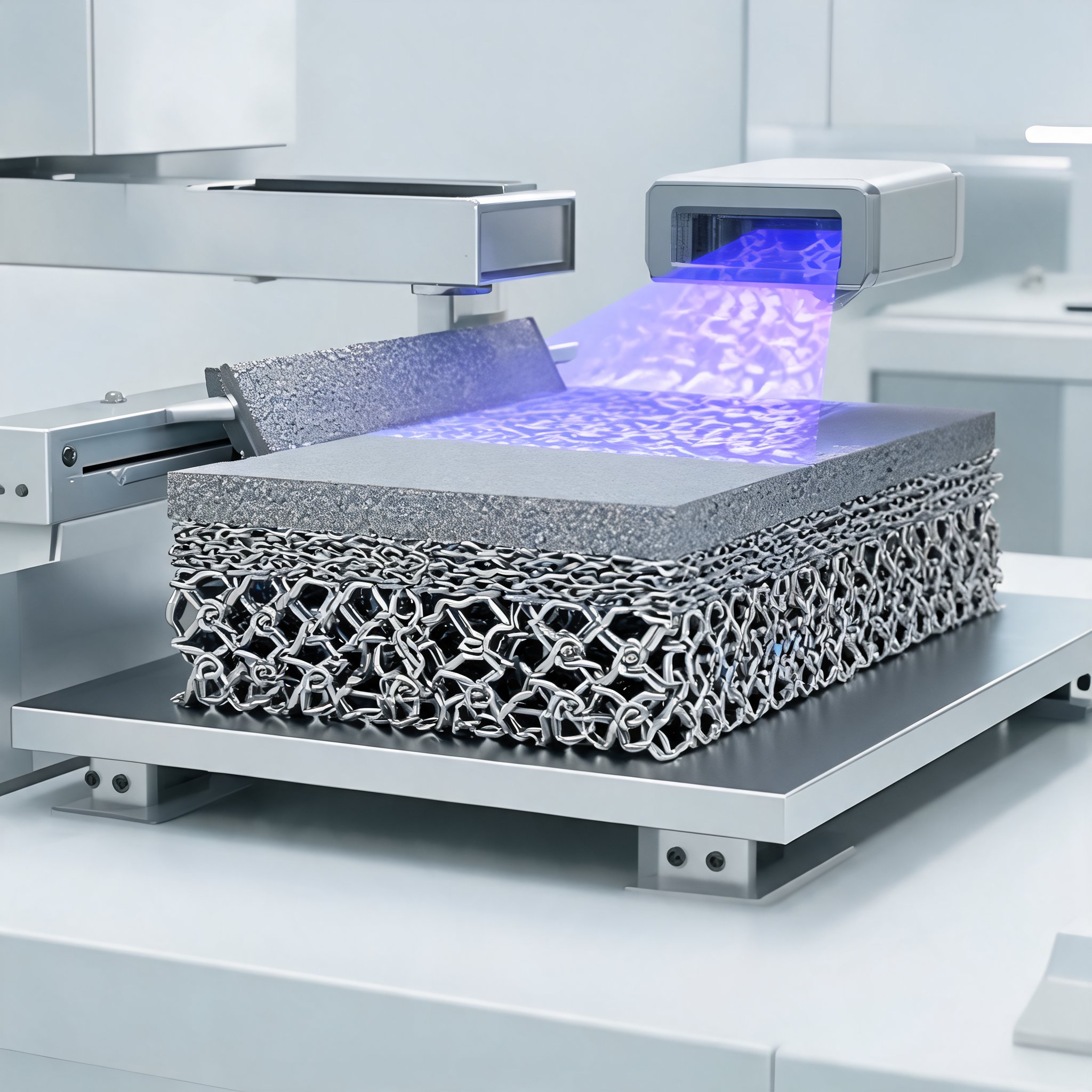
Northwestern University researchers have developed a hybrid 3D printing method, direct ink additive lithography (DIAL), that aims to combine the material range of extrusion printing with the speed and resolution associated with light-based processes. The work, led by Pranav Kaarthik and published in Science Advances, focuses on thick, particle-filled inks that are difficult to print with digital light processing and slow to deposit with direct ink writing.
The trade-off is central to the project. Digital light processing needs low-viscosity, weakly scattering resins. Direct ink writing can handle functional yield-stress inks, but it is slowed by filament deposition and limited by nozzle diameter. DIAL is presented as a way to reduce that compromise.
How the process works
For each layer, a slot die extrudes ink onto a substrate. A doctor blade scrapes the material into a sheet as thin as 25 microns. A 405-nanometer projector then travels over the sheet and crosslinks selected regions. Uncured ink remains in place as support. Because light only has to pass through a thin sheet, opaque, heavily filled inks remain printable. The projector's 50-micron pixel pitch sets planar resolution.
This sequence changes the function of the ink and the light. In DLP, the resin must let light through and remain flowable. In DIAL, the ink is first formed into a thin sheet, so the optical path is short and the material can be opaque or heavily loaded. The doctor blade controls thickness; the projector controls where the sheet solidifies; the uncured ink provides support. The process is therefore not simply a faster extrusion head or a more tolerant projector. It is a layer-forming approach that separates deposition, planarization and selective curing.
What the demonstrations show
Using a model ink made from a polyurethane-based resin thickened with fumed silica, the team printed a 60 mm by 40 mm log pile structure in 30 minutes, compared with 124 minutes for DIW. They also produced fins about 150 microns thick. In another demonstration, rastered projection over overlaid ink sheets created a multimaterial lattice four times the projector's illumination area.
The researchers also printed interlocking chain mail with struts about 250 microns thick, 15 gyroid structural electrolyte lattices from an ionogel ink in a single 15-minute run, and hydrogel cell culture inserts containing 0.5-mm-deep inverted pyramids. These examples span structural forms, electrolyte architectures and soft hydrogel geometries. They indicate that DIAL can be applied across several ink types, although the report does not establish a general formulation rule for doing so.
Where the speed claim needs context
The authors describe their print times as conservative because tool changes had not been tuned for speed. That caveat is important. The 30-minute versus 124-minute comparison is a useful benchmark for the reported log pile geometry, but it is not a general throughput forecast. The method still involves slot-die extrusion, doctor-blade sheeting, projector movement and layer handling. Its practical speed will depend on how those steps are integrated and on the area and thickness of each layer.
The authors also point to the absence of suction and peel forces seen in vat-based printing as a reason to expect easier expansion of build area and volume. That is a design argument rather than a demonstrated production result. It suggests that DIAL may avoid some constraints of resin vat systems, but it does not by itself establish how large-area tools will perform.
What it could mean for manufacturing
Ryan Truby, June and Donald Brewer Junior Professor of Materials Science and Engineering at Northwestern University, described the current choice between needed materials and desired printing speed, resolution and scale. He said DIAL lays a foundation for eliminating that compromise. He added that because DIAL can print many complex, functional parts at once, the team sees a path toward scaling it from the lab to larger-volume manufacturing of architected materials for robotics, aerospace, healthcare and other applications.
Those application areas are broad, and the published results are early-stage demonstrations. The reported results include a model ink, several printed geometries and a single-run array of 15 electrolyte lattices. They do not include mechanical testing, electrochemical performance, cell culture outcomes or cost data. The case for DIAL therefore rests on process capability: thick, filled inks; fine planar features; support from uncured ink; and parallel projection over an area larger than the projector's illumination field.
What remains to be proven
DIAL's promise depends on more than a fast layer. The process must show that printed parts retain the functional properties expected of their inks, that layer interfaces are sound, and that the approach can be scaled without losing resolution or material uniformity. The authors have been listed as coinventors on a U.S. provisional patent application, and funding came from the National Science Foundation, the Air Force Office of Scientific Research and Northwestern's McCormick School of Engineering. These details place the work in an academic translation context, but they are not evidence of commercial readiness.
For now, DIAL is best understood as a process architecture that addresses a specific limitation: light-based printing has required resins that light can penetrate, while extrusion printing has been constrained by nozzle-based deposition. By sheeting opaque ink before projection, DIAL makes thick, functional inks compatible with area-selective curing. Whether that translates into production tools for architected materials will depend on engineering the surrounding hardware, ink formulations and validation for each application.