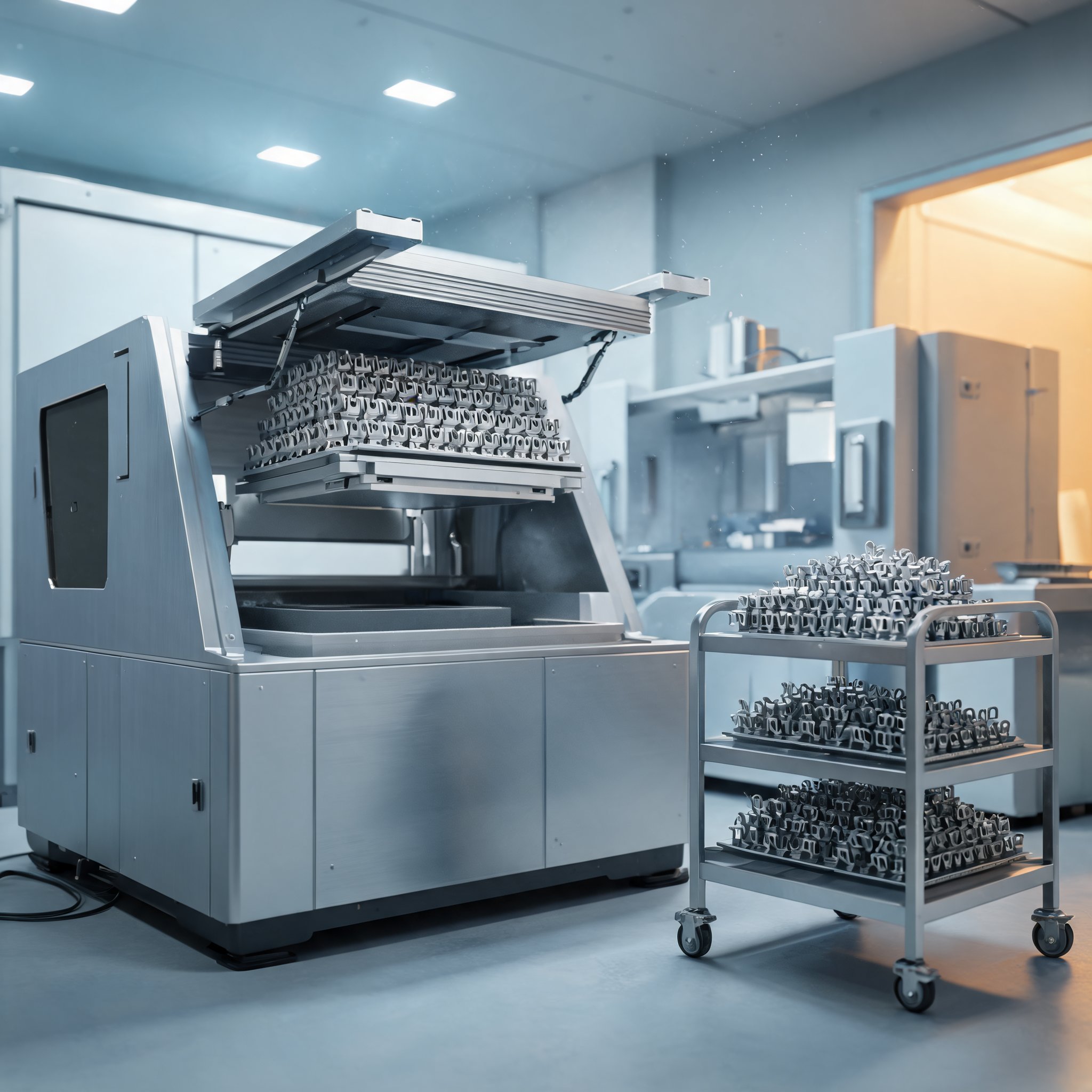
3T Additive Manufacturing now derives roughly 70% of its revenue from production orders, commercial director Eddie Andrews says, a shift that has changed how the Newbury-based metal printing business decides which jobs to take since he joined in November 2021.
When Andrews arrived, the company could make a one-off metal component for any one of hundreds of customers. The harder problem was winning the order to make the same part again, at the agreed price and on schedule. Andrews framed the challenge as turning specialised work into something closer to ordinary manufacturing, asking how the business could make repeatability “boring”.
Process ownership changed before the equipment did
3T-AM traces its history to 1997 and took delivery of its first metal machine around 2008. By 2021, years of accommodating individual prototype jobs had left what Andrews described as process piled on process. The company narrowed its customer base, gave larger accounts more influence over what it developed and simplified procedures that had accumulated, while much of the work stayed manual as the team established which operations it could reliably repeat.
Responsibility for a job moved as well. Previously the first person to see a drawing was the engineer who would print it, so decisions started from the question of how the part would be built. Today a product owner is accountable for delivering the finished component, and print and machining specialists agree the condition a part should be in as it passes from one operation to the next.
Machining in-house and capacity sold before delivery
Andrews argues that becoming a successful additive manufacturer depends on being a strong CNC machining company. Bringing machining in-house gave the SME tighter control over cost, quality and delivery dates, while larger multi-laser machines raised productivity at the printing stage. Neither investment on its own, he notes, tells a customer when a finished part will arrive.
The buying logic for EOS metal printers has shifted with it. Where 3T-AM might once have bought an M400 to try a different material and see what business it could develop, incoming machines are now largely accounted for by customer programmes before they reach the factory floor.
Demand mix and the prototype pipeline
Semiconductor customers generate the strongest demand, followed by energy, then space and defence. Aerospace remains central to the company’s plans, but 3T-AM has found work for its machines while it waits for more aerospace programmes to reach suppliers at volume. New product introduction still absorbs around 80% of the team’s time, and repeat orders give the business room to choose which development jobs to accept — some of which will never become production contracts.
SBO ownership and a seven-printer expansion
Austrian precision manufacturing group SBO acquired 3T-AM in October 2025; the Newbury business had generated sales of around £5 million in 2024. SBO brought experience in machining downhole drilling equipment, including components up to ten metres long, and was drawn by 3T-AM’s metal printing expertise and its access to a different set of industrial customers. The group approved a five-year business plan and asked whether it could be delivered sooner. In August 2026 SBO reported that 3T-AM had added an EOS M400 in the second quarter, ordered another printer and invested further in post-processing, as part of a seven-printer expansion across its UK and US operations.
Cost, qualification and carbon data
For some customers, replacing a casting with a printed part earns its keep through lead time alone. At higher volumes the calculation gets tougher: maintenance contracts and consumables weigh on the hourly rate, and a factory working a single shift has fewer productive hours over which to spread them — one reason Andrews looks to CNC shops that operate around the clock. Support removal, still dependent on what an experienced operator knows about a particular job, is a candidate for automation.
A project with Honeywell Aerospace, funded by the Aerospace Technology Institute, will put another claim to the test. The partners are converting an existing conventionally manufactured component to additive, and the sustainability team at the NCC in Bristol is carrying out a 12-month life-cycle assessment covering manufacture, service and end of life, comparing the printed route with the incumbent one. 3T-AM is also developing digital product passports as it connects its factory and enterprise systems; Andrews wants carbon information to accompany every part at no extra charge by the end of 2028.